

Monday Madness: Luna, Dionysus, and the Sacred Art of Losing One’s Mind
- Paul

- Dec 10, 2025
- 3 min read
The Moon’s Lunacy and the God’s Ecstasy in Ancient Sorcery
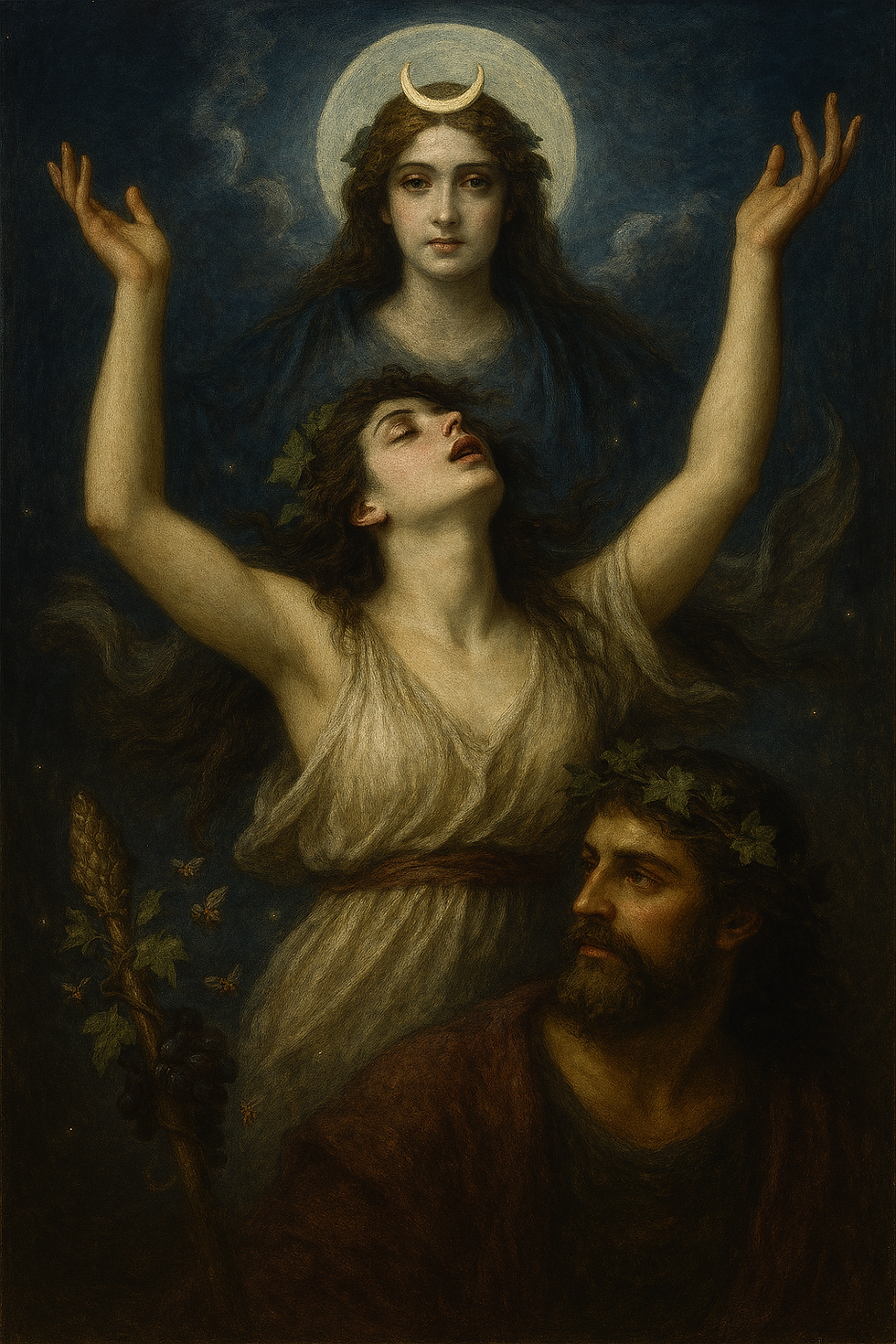
The ancients believed that madness was not merely an affliction but a visitation — a moment when the boundary between mortal and divine thinned. Two powers were most often invoked in this threshold state: Luna, whose shifting light stirred the tides of the mind, and Dionysus, whose presence dissolved the self in ecstasy.
Though their myths rarely intertwine directly, their domains overlap in ways that shaped ancient understandings of mania, trance, and the altered states central to Sorcery and Mageia.
🌙 Luna and the Origins of Lunacy
The Roman goddess Luna (Greek Selene) was more than a celestial body. She was believed to influence:
sleep
dreams
emotional volatility
irrational behavior
nocturnal visions
The term “lunacy” comes directly from her name. Roman physicians, philosophers, and astrologers taught that the Moon’s phases affected the brain’s moisture and humors, making individuals more susceptible to:
mania
frenzy
prophetic dreams
trance states
sudden emotional upheaval
In other words, Luna was seen as a cosmic trigger for the very conditions that open the gates of altered consciousness.
🍷 Dionysus and Divine Madness
Where Luna caused madness, Dionysus sanctified it.
The God’s presence was known through:
ecstatic dance
trance
possession
loss of inhibition
dissolution of the ego
visionary states
In Greek thought, Dionysian madness (mania) was not a disorder but a holy force — a divine eruption that freed the soul from its constraints. His Bacchanalians sought this state intentionally, using rhythm, wine, movement, and ritual to enter the God’s current.
🧩 Where Their Powers Meet
Though Luna and Dionysus do not share a direct mythic narrative, their symbolic overlap is profound:
1. Night as the Realm of Ecstasy
Luna rules the night; Dionysus rules the ecstasy that unfolds within it.
2. Madness as Transformation
Luna destabilizes the mind. Dionysus reshapes what remains.
3. Emotional Release
Both deities were invoked in rites of catharsis, grief, fertility, and rebirth.
4. Influence on Women’s Rites
Lunar cycles governed women’s mysteries. Dionysian rites were historically dominated by women — the Maenads, the Bacchantes.
5. The Threshold State
Luna opens the door. Dionysus invites the soul through it.
This shared domain makes them natural partners in symbolic Sorcery.
🗓️ Why Monday?
Monday is Moon‑day, dedicated to Luna. It is the day historically associated with:
emotional sensitivity
prophetic dreaming
instability
inspiration
irrational impulses
In the Temple of Bacchus, this becomes an opportunity:
Monday is the day when Luna loosens the mind, and Dionysus fills the space she opens.
Thus, Monday Madness becomes a celebration of the sacred art of losing one’s mind — not in chaos, but in revelation.
🔥 Monday Madness in Bacchanalian Sorcery
A Monday Madness practice might include:
lunar offerings (milk, honey, white wine)
ecstatic dance under moonlight
trance meditation
invocation of Luna to open the mind
invocation of Dionysus to fill it with ecstasy
journaling visions or emotional surges
ritual release of tension or grief
This is not madness as pathology, but madness as threshold — a moment when the self becomes permeable to the divine.
🏛️ Conclusion: The Moon Opens, the God Enters
Luna and Dionysus together form a powerful polarity:
Luna destabilizes
Dionysus transforms
Their combined influence creates a ritual current ideal for Bacchanalian Sorcery — a current of revelation, emotional release, and ecstatic insight.
Monday Madness is not a gimmick. It is a weekly reminder that the mind is not a prison but a doorway.
Copyright © 2025 Paul Reed
All rights reserved.


Comments